Forecourt signage that works under pressure
A filling station is a fast-moving site. Drivers are turning in, looking for pumps, checking prices, finding the shop and reading directions in a few seconds. Good signage has to do that job clearly, even in heavy traffic, rain, dust and early morning glare. We plan signage for the full customer path, from the road edge to the convenience store and back out again.
For filling stations in Pretoria, Akasia, Rosslyn and along busy routes into Centurion, we usually start with visibility from the approach road. That means fascia signs, price boards, canopy graphics, directional boards and shopfront branding that can be read at speed. On sites with night trading, we also look at illumination, reflective detail and placement so the site still reads properly during load-shedding or after dark.
Typical equipment on a fuel retail site
Most forecourt projects use a mix of permanent and changeable signage. The exact set depends on the size of the site, the number of pumps, and whether the station includes a convenience shop, car wash or quick-service tenant.
- Canopy fascia panels with cut vinyl or printed graphics
- Price boards and fuel grade panels
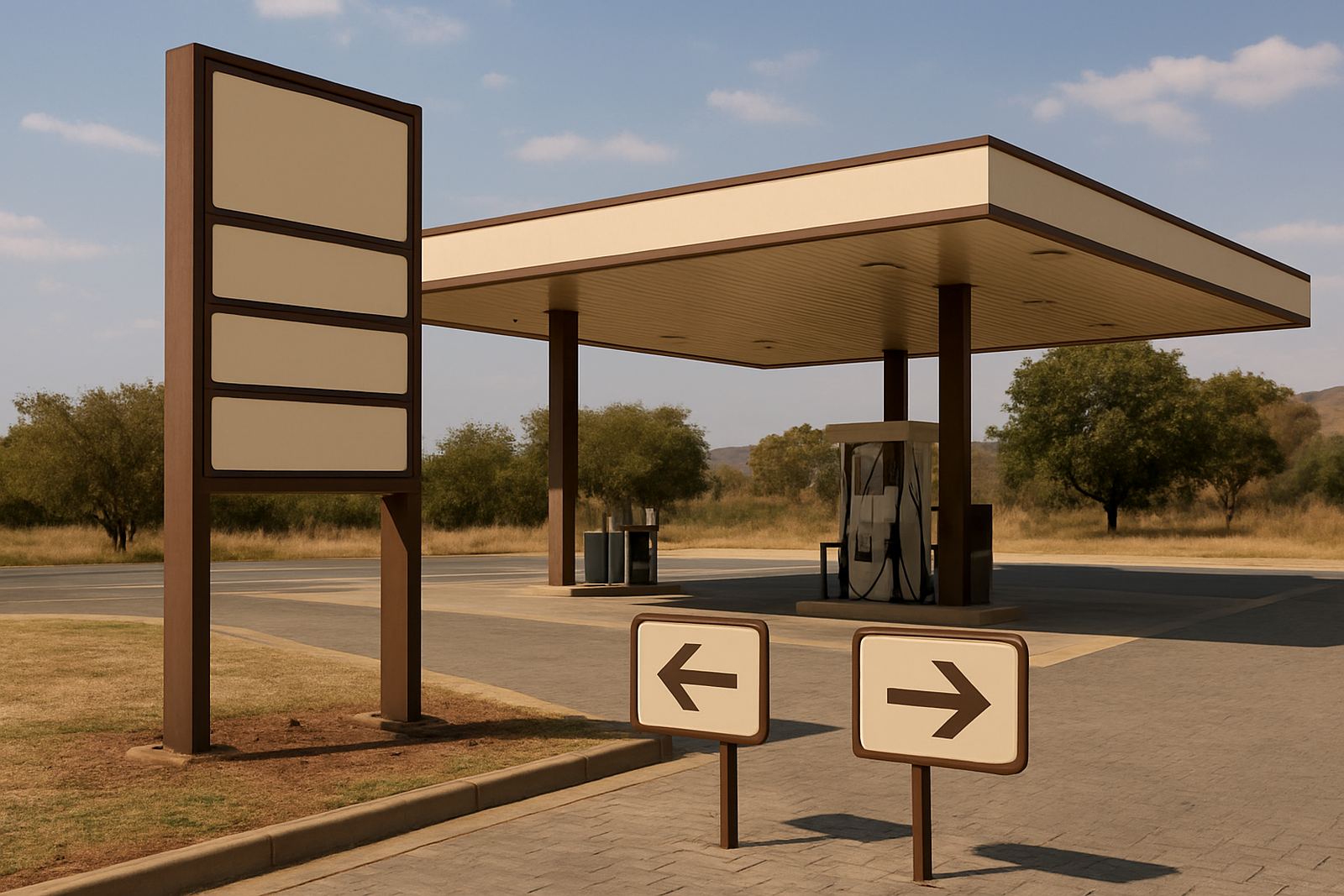
- Road-facing pylons and directional signs
- Shopfront sign panels and door graphics
- Pump decals, safety signs and bay numbering
- Window branding for specials, trading hours and services
- Promotional banners, swing signs and temporary campaign boards
- Vehicle wrap fitting for service vehicles or delivery vans
In wetter parts of Hartbeespoort and on sites exposed to coastal-style humidity from stored cleaning chemicals and daily wash-downs, material choice matters. We use sign faces, adhesive films and fixings that hold up to sun, rain and routine cleaning. Steel structures must be sealed properly, and print finishes need to stay readable after dust and fuel vapour exposure.
Layout planning before anything is made
A neat filling station is usually the result of good planning, not just good-looking signs. Before production, we do site surveys and check sightlines, mounting points, traffic flow, power access and permit requirements where relevant. That helps avoid signs that block views, conflict with municipal rules, or slow down the installation team later.
For fuel retail environments we normally map the site in layers: road visibility, forecourt guidance, pump area messaging, then shop and service branding. If the station is on a narrow stand or has a tight entrance, directional signs must be clear but not cluttered. Too much copy creates hesitation at the pumps and can make the site feel untidy.
We also check the timing of the rollout. If your station is trading throughout the project, the work often needs to happen after hours or in phases. That keeps disruption low and helps the site stay safe for staff and customers. Where there is a launch or rebrand date, the installation sequence needs to match stock arrival, permit approval and store opening dates.
Common mistakes that cost time and money
Fuel retail signage fails for simple reasons more often than people expect. A board can be the right size but placed too low, or it can look good in the workshop and disappear once it is mounted behind a canopy beam. We help clients avoid those mistakes before fabrication starts.
- Using fonts that are too thin for fast roadside reading
- Overloading price boards with extra wording and icons
- Choosing materials that fade quickly in strong sun
- Ignoring wind load on large panels and banners
- Leaving no access for maintenance, cleaning or bulb replacement
- Installing temporary campaign signs where they block safety messages
- Skipping permit checks for outdoor structures and roadside signage
Another common issue is poor coordination between design and site teams. If the graphic layout is not matched to actual dimensions, the final sign can look stretched or cramped. Small errors also become expensive when they need a reprint after fabrication. Our process keeps artwork prep, measurements and installation in the same chain so the details stay consistent.
Budget ranges for filling station signage
Budgets for fuel retail signage vary a lot depending on the number of signs, the level of finish and whether the site is a refresh or a full rebrand. A basic maintenance job with a few replacement faces and vinyl updates may start from about R12 000 to R35 000. A medium rollout with canopy branding, shopfront graphics, directional boards and some printed promotion work often sits between R45 000 and R120 000.
For larger forecourt projects with multiple structures, illuminated elements, price boards, custom fabrication and full installation planning, budgets can range from about R150 000 to R450 000 or more. Permit assistance, after-hours work and phased rollouts can affect the total. It is better to scope the whole site properly than to keep adding pieces later, because repeated call-outs and rework usually cost more.
We are often asked to separate essentials from nice-to-haves. The essentials are the signs that guide drivers and support trading, while extras like promotional flags, seasonal boards and campaign displays can be phased in once the main site is complete.
What HM Graphics & Signs handles on fuel retail projects
We work from concept through to installation, which helps keep the look consistent across the forecourt and the store. Our team in Hartbeespoort serves Pretoria, Tshwane, Brits, Centurion and surrounding areas, and we are used to working on live sites where access is controlled and timing matters. Hendrik Mokoena oversees the business, with support from Lerato Mthembu on operations, Riaan Odendaal on production, Ayanda Mavuso on graphic design, Kagiso Ndlovu on installation, Revasha Desai on client service and Retief Wessels on fabrication.
For filling stations, that usually means a clear sequence: site survey, layout advice, artwork prep, production, then installation and final checks. If you need maintenance or a refresh after weather wear, we can replace panels, update campaigns and tidy up older branding without disrupting trading more than necessary. Clients reach us through the enquiry form on our contact page, and we use that first step to confirm the site, the scope and the most practical way to phase the work.
When a forecourt looks organised, customers move faster and the site feels more professional. That matters whether you run one station or several across Gauteng.