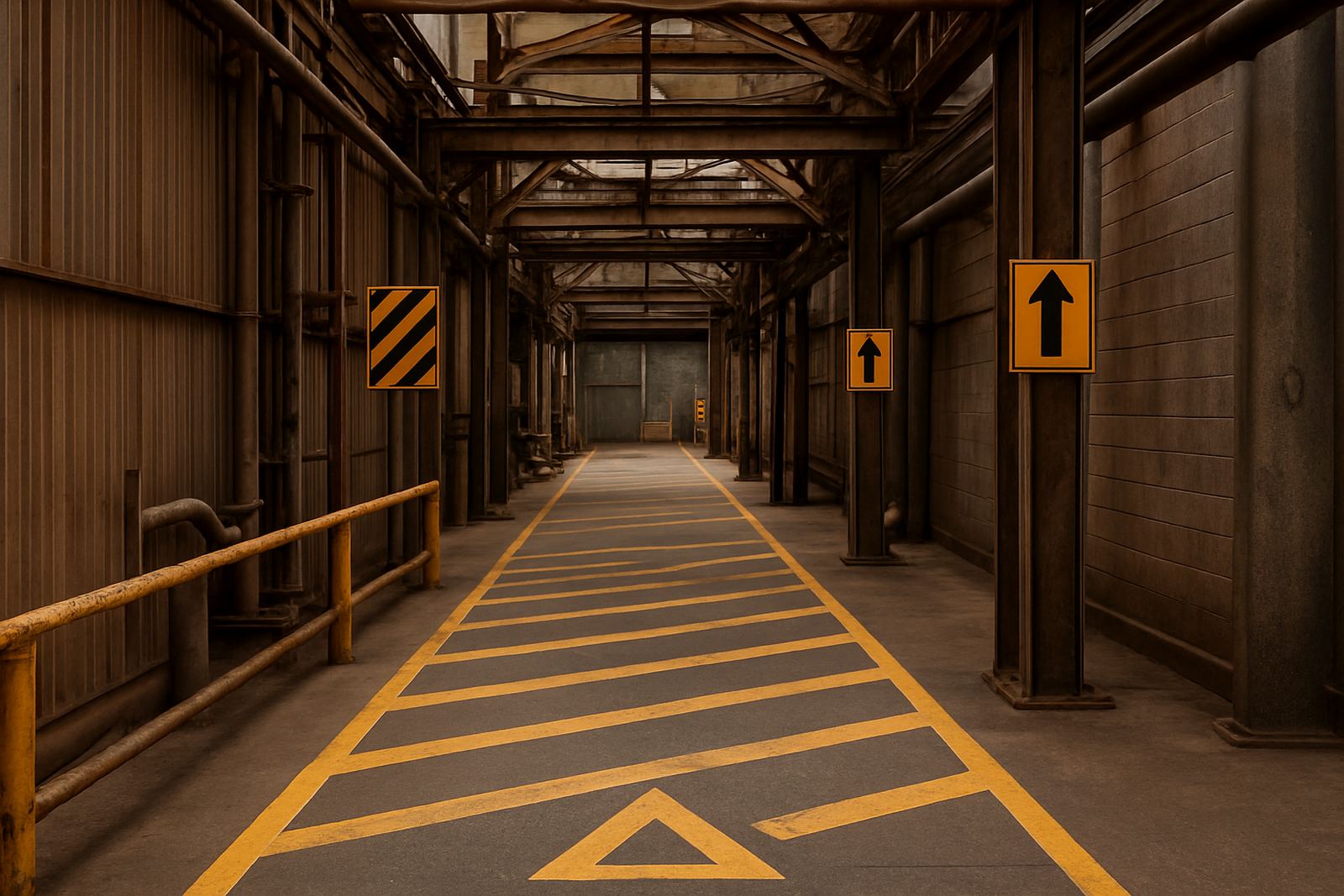
A Production Site That Needed Clearer Flow
The client was a manufacturing site in Ga-Rankuwa with multiple access points, machine zones, pedestrian routes and storage areas that had grown over time. Staff were moving between production, dispatch and maintenance areas every day, but the signage was inconsistent and in some places missing altogether. The result was avoidable confusion at key junctions, especially during shift changes and supplier deliveries.
They asked us to standardise the site with practical safety signage, directional markers and compliance notices that would support day to day operations. The aim was not just to fill wall space, but to make movement easier, reduce uncertainty and give each zone a clear identity. We worked with the site team and safety representative to map out where each sign needed to go.
- Factory safety signs for restricted areas and hazard points
- Directional signs for visitors, staff routes and loading areas
- Compliance signs for PPE, emergency access and no entry points
- Zone identification for production, stores and dispatch
Surveying the Site Before We Made Anything
We started with a site survey to measure wall spaces, note visibility from walkways and check the mounting surfaces. In a working factory, placement matters as much as the wording. Some signs had to be readable from a moving forklift, while others needed to be seen at eye level in narrow corridors. We also checked areas where dust, moisture and regular wash-downs could affect the finish.
The client wanted signs that would stay legible in indoor industrial conditions and under mixed lighting. In some sections there were bright openings near roller doors, while other areas had shadow and poor natural light. We adjusted the layout for each section instead of using one standard size everywhere, which saved time later and reduced visual clutter.
- Measured each installation point on site
- Checked line of sight from main access routes
- Matched materials to indoor industrial use
- Marked areas for drilling, fixing and adhesive mounting
Design, Artwork Prep and Sign Specs
Our graphic design team prepared the artwork with a clean hierarchy so the main instruction was visible first and supporting text followed underneath. Where required, we used standard safety colours and pictograms, together with site-specific wording supplied by the client. The aim was consistency across the whole premises, from entrance points through to plant areas and service corridors.
The final set included a mix of rigid signs and self-adhesive markers. Most were produced on durable rigid board in sizes ranging from 300 x 450 mm to 600 x 900 mm, depending on viewing distance. We used UV-stable print for colour consistency and added laminated protection on signs exposed to regular cleaning. A few smaller labels were cut in vinyl for doors, switches and direction arrows. Nothing fancy, just the right sign in the right place.
- Rigid safety boards in multiple sizes
- Vinyl cut labels for doors, arrows and equipment points
- UV-stable print for long-term colour hold
- Laminated finish on signs exposed to frequent cleaning
Manufacture and Installation Without Interrupting Production
Because the site remained active throughout the project, we planned the work in stages. Our production team manufactured the signs in-house, then the installation lead arranged fitting around operating hours and access restrictions. We completed the work over 3 weeks, moving from the high-traffic zones first and then finishing the lower priority areas once the client had confirmed the final layout.
Installation included drilled fixings where needed, adhesive mounting on smooth internal surfaces and careful placement near machinery and walkways. We made sure each sign sat straight and was easy to read from the intended approach. In a busy site, even a 20 mm misplacement can make a sign look off, so we checked every panel before leaving each section.
- Completed in 3 weeks from survey to final handover
- Installed in stages to keep production moving
- Used mixed fixing methods for different surfaces
- Checked alignment and legibility on every section
What Changed After the Signs Went Up
Once the signage was in place, the site had a much clearer flow. Visitors could find the right office or loading point without hunting around, and staff had better visual cues around restricted zones, emergency paths and equipment areas. That sort of clarity helps with daily discipline because people do not need to guess where they are allowed to go.
The client also reported fewer repeated questions at the gate and less confusion during deliveries. For a production environment, that saves time and takes pressure off supervisors. The signs now give the site a consistent visual standard, which is important when new staff arrive or when a contractor comes in for a short job. It also makes audit prep less stressful, especially when safety checks are due and time is tight.
- Clearer visitor movement through the site
- Better visibility of restricted and hazard areas
- Fewer delays at access points and loading zones
- Improved consistency for audits and safety checks
What We’d Repeat on Another Safety Sign Site
If we were starting a similar project again in Ga-Rankuwa or any other industrial area, we would keep the same approach: site survey first, then artwork, then staged installation. That order works because it avoids guesswork and helps the client see exactly where each sign will sit before production begins. It also leaves room for practical changes if a passage is narrower than expected or a machine layout has shifted.
We would also keep using a mixed material approach rather than forcing every sign into one format. Some locations suit rigid boards, while others only need vinyl markers or smaller directional panels. For factories working through load shedding, dust and day-to-day wear, it makes sense to choose materials that are easy to maintain and simple to replace later if a section changes. That kind of planning avoids wasted spend, and keeps the site tidy.