

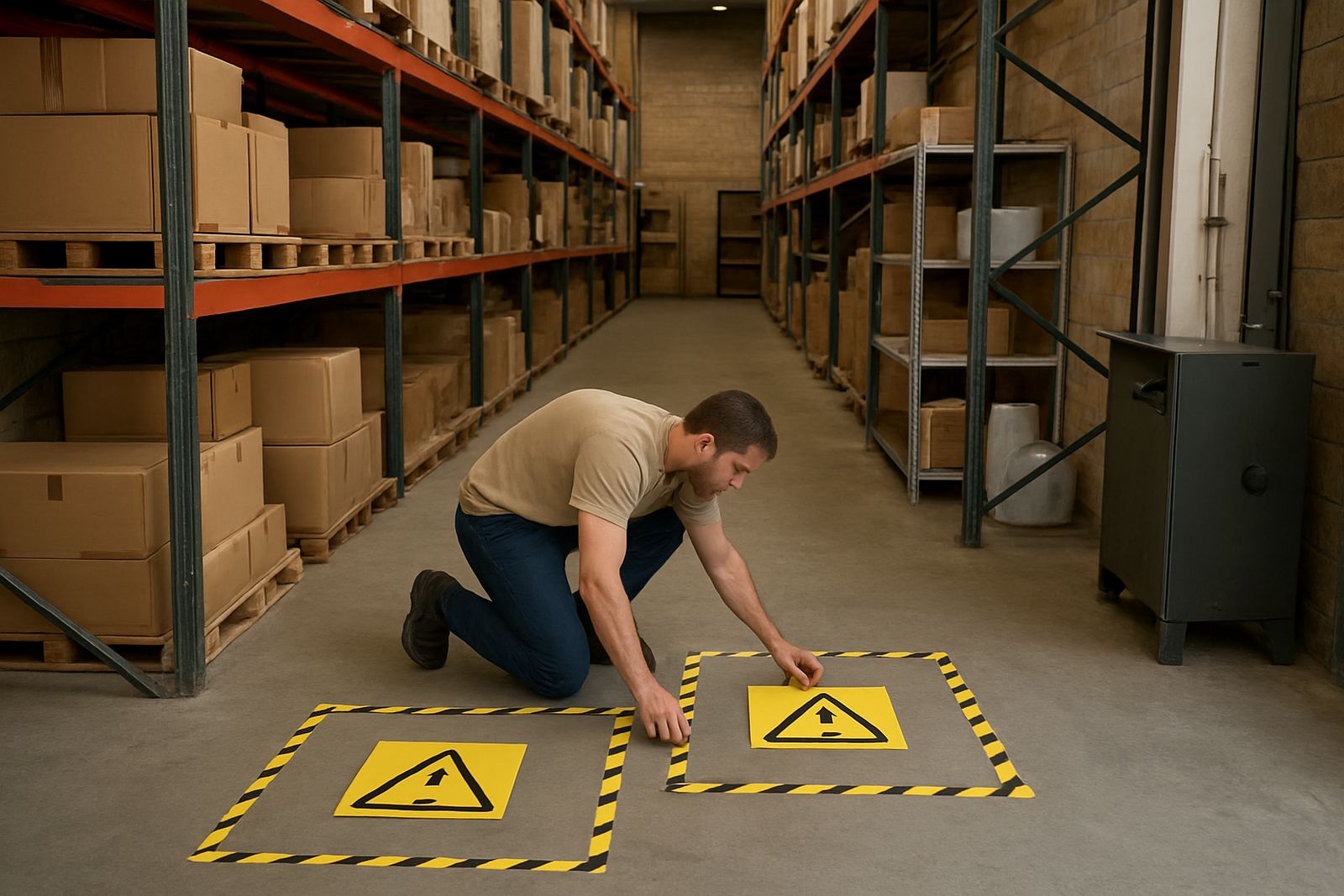
Start with the risk, not the wall space
Before a sign is fitted, the site team should ask a simple question: what behaviour must this sign change? A warning at a machine, a no smoking notice near gas storage, or an exit direction in a loading bay each need different placement. If the sign is too high, hidden by stock, or mounted where staff walk past too quickly, it becomes part of the background and people stop noticing it.
The best rule is to place the sign where the decision happens. If the hazard is at floor level, the sign should catch the eye before someone steps into the area. If it relates to a doorway, gate, switchboard, or access point, the message must be on the approach side, not only on the equipment itself. In a busy Gauteng site with contractors, forklift movement and shift changes, that split-second matters.
- Match the sign to the specific hazard or instruction
- Place it where the person first sees the risk
- Avoid clutter that competes with the message
- Check that stock, doors, gates, or vehicles will not block it
Keep it at eye level and in the right line of travel
Eye-level placement is a good starting point, but the real test is how people move through the space. In passageways, the sign should sit in the natural line of sight, not behind a beam or at a corner where people are already turning away. In wide areas such as distribution yards or municipal depots, larger signs may need to be mounted higher so they stay visible over parked vehicles and stacked materials.
For pedestrian zones, the average viewing height is usually around 1,500 mm from finished floor level, but the exact position depends on the site layout. A warning sign near a stairwell may need to be slightly above eye level to avoid being missed by someone already looking down at the steps. In a loading area, the opposite may apply, since operators are scanning the ground and vehicle movement more than the upper wall space.
- Use sightlines, not only wall height, to set placement
- Allow for people walking, driving, or carrying stock
- Fit larger signs where viewing distance is greater
- Do not place critical signs behind open doors or parked plant
Think about light, weather and load-shedding
Visibility changes through the day. A sign that looks clear in the morning can disappear at dusk, in a dim workshop, or during load-shedding when the site shifts to backup lighting. If a safety message depends on being read in poor light, it needs reflective material, better lighting, or a position closer to the working area. On outdoor sites, glare can be just as bad as darkness, especially on bright North West afternoons or where sunlight bounces off pale walls and concrete.
Coastal humidity is not the only issue in South Africa, but moisture, dust, heat and cleaning chemicals all affect sign life. In Pretoria and Hartbeespoort, outdoor signs also need to stand up to strong sun and seasonal storms. A sign may start off in the correct position, then fade, warp or loosen if the fixing method is not right for the surface. That is why placement and fixing should be planned together, not as separate tasks.
- Test the sign at different times of day
- Use reflective or high-contrast materials where lighting is poor
- Check that emergency signs remain readable during load-shedding
- Choose fixings suited to brick, steel, plaster or cladding
Use size, colour and repetition to back up placement
Even the best-positioned sign has limits if it is too small or visually weak for the environment. A simple rule is that distance drives size. If staff must read the sign from across a yard, it needs stronger contrast and larger lettering than a sign inside an office corridor. Colour helps too, but it must stay consistent with the meaning of the message. People learn patterns quickly, so a warning sign should not look like a general notice board.
Where a risk appears in more than one place, repeat the message. A single sign at the entrance is not enough if the hazard is repeated down the line. For example, a production area may need one sign at the entrance, another at the machine, and a floor marking at the actual danger zone. Repetition improves compliance because it reaches people at the point of action, not only on arrival.
- Increase size for longer viewing distances
- Keep colour use consistent with the message type
- Repeat signs where the risk repeats
- Pair wall signs with floor markings when needed
Plan for daily operations, cleaning and maintenance
A sign should stay effective after the first week, not only on installation day. Forklifts, trolleys, cleaning routines and temporary stock changes can all shift a sign out of position. If a site uses movable cages or mobile equipment, the sign may need to be mounted higher or installed on a dedicated post. In a maintenance bay, it helps to leave enough clearance so the sign is not scraped every time a panel, ladder or scaffold moves past.
Maintenance is also part of compliance. Once signs become dusty, cracked or partly hidden, they stop doing their job. Regular checks should include visibility, fixing points, legibility and whether the message still matches the current risk. It is common for a site to add a new process, then leave old signs in place. That creates confusion and can weaken the whole safety system.
- Inspect signs during routine safety walks
- Replace faded, damaged or outdated signage quickly
- Move signs if site layouts change
- Keep temporary branding or campaign material away from safety notices
A Pretoria warehouse example: where placement makes the difference
Consider a warehouse in Pretoria with receiving bays, pallet racking and a pedestrian route to the packing line. The site has a fire exit, a no unauthorised entry point, a machine hazard zone and an emergency assembly area outside. If the exit sign is mounted too close to the door frame, it can be missed by people carrying stock. If the machine warning sign sits above a racking beam, drivers may not see it until they are already turning.
A better approach is to place the exit marker on the approach wall, the machine warning at shoulder height near the access point, and the assembly point sign where staff naturally gather after leaving the building. That way, each sign supports a decision at the exact moment it is needed. It is a simple change, but it improves day-to-day behaviour and reduces the chance of confusion during an incident.
For sites across Tshwane, Akasia, Rosslyn and Soshanguve, the same principle applies: sign placement must follow movement, not just the nearest free surface. Good installation turns a sign from decoration into a working safety tool.